
Evaluating Accuracy of DSRC GPS for Pedestrian Localization in Urban Environments
Published in, RISS Working Papers Journal, 2018
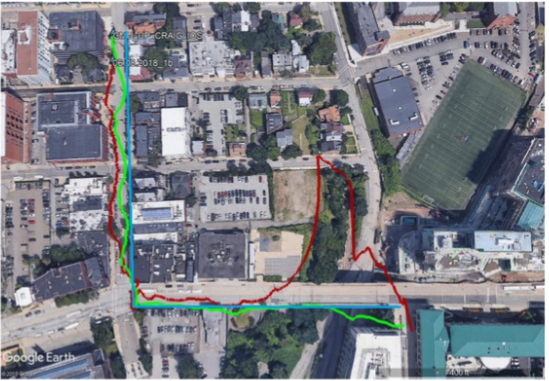
We quantify how much localization drift DSRC GPS introduces for pedestrians and show that fusing smartphone and DSRC sensors recovers reliable low-speed tracking for safety-critical interactions.
Abstract
Dedicated Short-Range Communications (DSRC) radios promise to reduce collisions between pedestrians and vehicles by enabling direct vehicle-to-infrastructure communication. Unfortunately, the commercial DSRC GPS units available today lose fidelity at the very walking speeds that matter most. We deployed a month-long urban field study to quantify this drift, capturing more than 20 hours of pedestrian trajectories that expose bias and variance patterns across both open-sky intersections and dense urban canyons.
Drawing on these measurements, we designed a sensor-fusion pipeline that combines smartphone GPS, inertial sensing, and DSRC telemetry. By dynamically weighting each modality as velocity changes, the fused estimate curbs low-speed error enough to restore reliable crosswalk tracking without any hardware modifications. The resulting dataset and code offer a realistic baseline for cities planning DSRC deployments aimed at protecting vulnerable road users.